


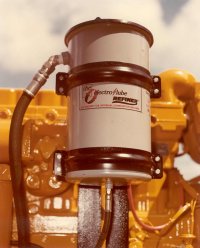
Another division acquired by Fruehauf’s Jacksonville Shipyards was ElectroLube Devices, Inc. The company had developed an on-engine bypass oil filtration system that purified lube oil beyond manufacturers’ specifications.
A shipyards is a dirty, gritty workplace, a terrible environment to run any engine. The huge Caterpillar diesel generators ran 24/7, their oil had to be changed every 500 hours, and every 5000 hours they were supposed to be overhauled completely.
This environment was perfect for testing and perfecting a product such as the Electro-Lube Refiner. With regular inspection and testing, using the ElectroLube Refiner, the company was able to run their equipment for 35,000 hours and more without needing overhauls, and without needing to change the oil. The Refiner worked on engines as small as automobiles and as large as ocean tankers.
The challenge was to penetrate existing markets of engineers and contractors, and convincing them of their need for this new product. More than that, it involved educating the market that engine oil never really wears out, it just gets dirty, and if you can keep it clean, you never need to change oil again.
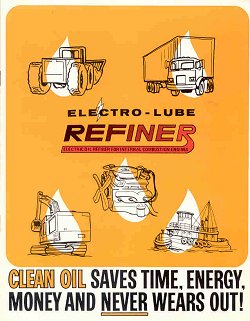
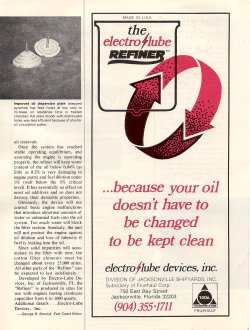
The existing company promotional collateral was terrible: tacky, expensive to produce, and full of features with very few benefits. There was no clearly-defined brand or even a logo that conveyed the image of the product very well. So Emerson’s first task was to redesign the company brochures, create a newer, cleaner logo, and develop the unique wording and phraseology that would eventually belong to the brand, ElectroLube.
The new logo he designed showed a stylized version of the actual process, and immediately conveyed the concept of dirty fluid being cleaned.
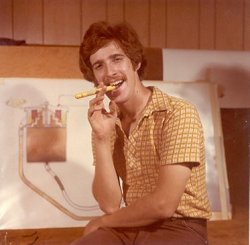
Continuing the development of this international brand, Emerson realized he needed to create a multimedia presentation that would demonstrate exactly how the Refiner cleaned the oil. This required animation, which had to be done by creating individual colored gels. The hard work was worth the efforts: the resulting presentation was used successfully by distributors worldwide for seven years before newer technology allowed the company to change it.
He also designed an inexpensive 10 x 12 tradeshow booth that could easily be set up at professional engineering and contractor meetings and events. He represented the company at various industrial shows as well.
Actively pursuing international PR opportunities, he successfully got articles published in prominent industry publications such as Design News magazine, resulting in hundreds of high quality engineering leads
All of these intense marketing efforts created a buzz in the industry, and the resulting demand required the company to expand its sales team from one person to twelve, in a period of four months. International manufacturers’ reps were soon added as well. To handle the explosive increase in orders, ElectroLube moved out of their cramped, shared offices at the shipyards and opened their own full production facility almost two years ahead of schedule.
As it was explained to him at the time he was hired, “A shipyards doesn’t know marketing, a shipyards knows ships. This stuff needs marketing!” Interestingly, when the shipyard’s assets were sold off in 1992, only ElectroLube and Key Houston remained as viable companies.